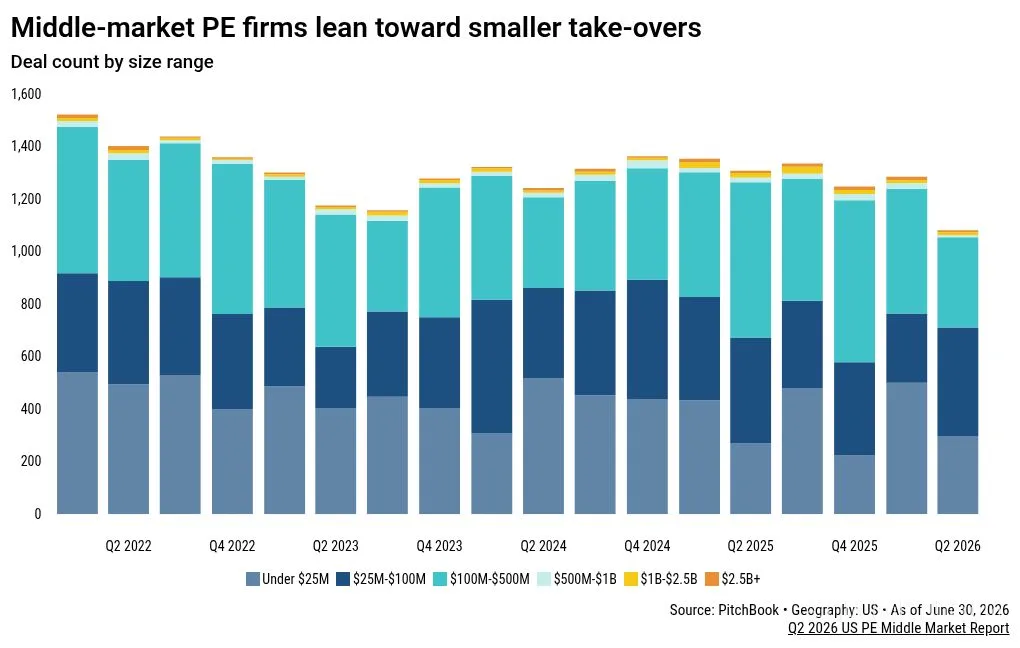
Middle-market buyout firms are seeking value by moving towards smaller deals. According to new data, in the second quarter of 2023, 413 private equity (PE) investment deals in the United States were completed, valued between $25 million and $100 million, totaling $16 billion. These figures represent a 56.4% increase in the number of deals and a 70.6% increase in deal value compared to the previous quarter.
Market Analysis and Decrease in Deal Size
This sector was the only bright spot in the middle market in the second quarter. While larger-value transactions, both in the upper middle market (deals between $500 million and $1 billion) and in larger markets, decreased. Only eight deals were completed in this segment, reflecting a decrease of about 64% compared to the previous quarter, with the total value of these transactions dropping to $5.7 billion.
Read more: General Motors Increases Its Digital Value to $114
The decrease in deal size is another sign of capital shifting towards lower market segments. The average deal value in the middle market in the first half of 2023 decreased to $151.9 million, down from $179 million in 2022.
Buying Strategy and Market Challenges
Instead of seeking large, integrated platforms to acquire smaller companies, investors are increasingly turning to buying small, founder- or family-owned businesses as platform and add-on companies. This strategy is growing in sectors such as industrial services, insurance brokerage, and residential services, which include small and scattered businesses. Paul Mahoney, a partner at the law firm Troutman Pepper Locke, noted that "initial purchases typically have lower value than usual, but they have a plan for growing the company through subsequent acquisitions."
One of the driving factors behind this shift is the current exit bottleneck. Fewer investors are selling their portfolio companies to the market, which has reduced the number of large-scale businesses available for buyers to choose from. Additionally, the limited investment-backed assets currently in the market often demand high prices.
These small businesses typically trade at EBITDA multiples between four to eight times, which is relatively lower than larger firms. According to Christopher Schaefer, global head of the PE group at Reed Smith, "dealmakers are increasingly inclined towards mergers and operational improvements, which can create strong opportunities for excellent returns."
In the first quarter of 2023, the entry multiple for companies with business values between $500 million and $1 billion reached 13.2 times EBITDA, up from 12.1 times in 2022. In contrast, average valuations for companies in the $25 million to $100 million range in the first quarter fell to 8.5 times, a decrease from the previous year.
Moreover, PE managers' hesitation to commit to larger purchases amid ongoing market volatility and rising energy prices has also contributed to the growth of smaller acquisitions. According to Mahoney, buyers' diligence for larger investments has increased compared to the past, and deals are taking longer to close due to price discrepancies between buyers and sellers.
The upcoming midterm elections in November may also pose challenges, especially for sectors likely to face increased regulatory scrutiny. If Democrats gain control of the House of Representatives, PE investments in healthcare and youth sports may be at risk. However, business activity is expected to rebound once the political outlook becomes clearer.
Read more: Return of Beef Cattle to the Market with Rising Futures Prices · Christopher Giordano, CEO of Tenax Therapeutics, Purchased Shares Worth $20,087