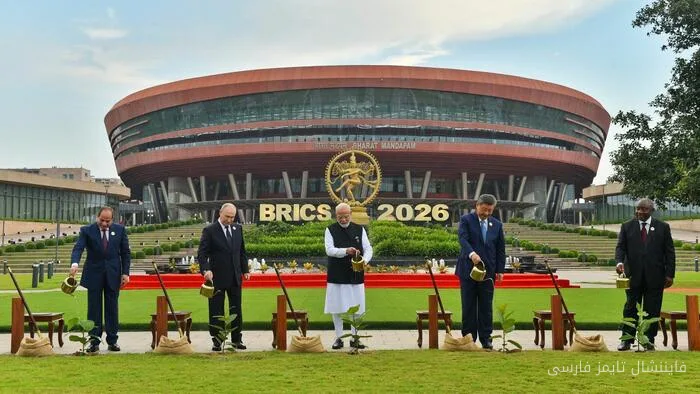
The annual summit of BRICS leaders in New Delhi began with the adoption of a statement expressing the deep concerns of the members regarding the escalation of tensions in the Middle East. The members of this group, including Brazil, Russia, China, South Africa, Egypt, Ethiopia, and Indonesia, emphasized the need for maximum restraint and avoidance of actions that could worsen the situation.
Efforts for Unity in the Face of Crises
The statement reads: "We express our deep concern regarding the continued escalation of tensions in the Middle East and West Asia, and while recalling our national positions, we call on all parties to exercise maximum restraint." BRICS has also addressed its common positions on international conflicts, sanctions and trade, reform of global institutions, finance, energy, technology, health, and development.
Read more: Trump: If I go back to Iran, I will do the same things
One of the serious challenges of this summit was the lack of agreement on condemning the United States' actions against Iran, as BRICS includes Iran and the United Arab Emirates, which are on opposing sides in this conflict. India, as the host of the summit, is also one of Israel's closest allies and one of its main arms suppliers.
Economic Consequences of Tensions
Following the unjustified attacks by the United States and Israel on Iran's nuclear facilities and civilian infrastructure, the country has effectively closed the Strait of Hormuz. This action has led to a sharp increase in energy prices and has put pressure on the economies of BRICS countries, especially in Asia. The BRICS statement also committed to the peaceful resolution of international disputes "through dialogue, consultation, and diplomacy."
Additionally, BRICS members expressed concern about "unilateral tariff and non-tariff measures" that disrupt trade and disturb supply chains. The statement also refers to recent economic actions by the United States, including threats of tariffs against China and India and economic sanctions against Iran and Russia.
Regarding Israel's actions in Gaza, the statement calls for the maintenance of a ceasefire and the facilitation of humanitarian aid without obstruction, opposing the forced displacement of Palestinians and territorial and demographic changes in Gaza. It also supports the right of Palestinians to self-determination and the establishment of a Palestinian state based on the 1967 borders with East Jerusalem as its capital.
On Lebanon, the statement calls on Israel to withdraw its forces from Lebanese territory and adhere to the Lebanese ceasefire and UN Security Council Resolution 1701. Regarding Syria, the statement calls for respect for Syria's sovereignty and a political process involving Syrians, warning of the dangers posed by "foreign terrorist fighters" to the stability and security of Syria and the region, and calls for the withdrawal of foreign occupying forces.
The statement also emphasizes the importance of reliable energy supply and stable markets, clearly stating that fossil fuels will continue to play a significant role in emerging and developing economies. At the same time, it supports a fair, orderly, just, and inclusive transition to renewable energy and the reduction of emissions, taking into account the varying conditions of countries.
Read more: European Court of Human Rights: Member States Are Not Obliged to Accept Yemeni Children · Opening of China's Defense Forum Amid Increasing Regional Tensions